
A Beatrix Potter Postscript About Her Museum Friendships, My Book on Kindle, Some April Recommendations

Apologies for posting again so soon. This recent spate of posts has been due to my sudden enthusiasm for writing about Beatrix Potter. This post is by way of being a postscript – see below – but I also thought I’d take the opportunity to flag that my book Mr Keynes’s Revolution is available for today only for 99p on kindle.
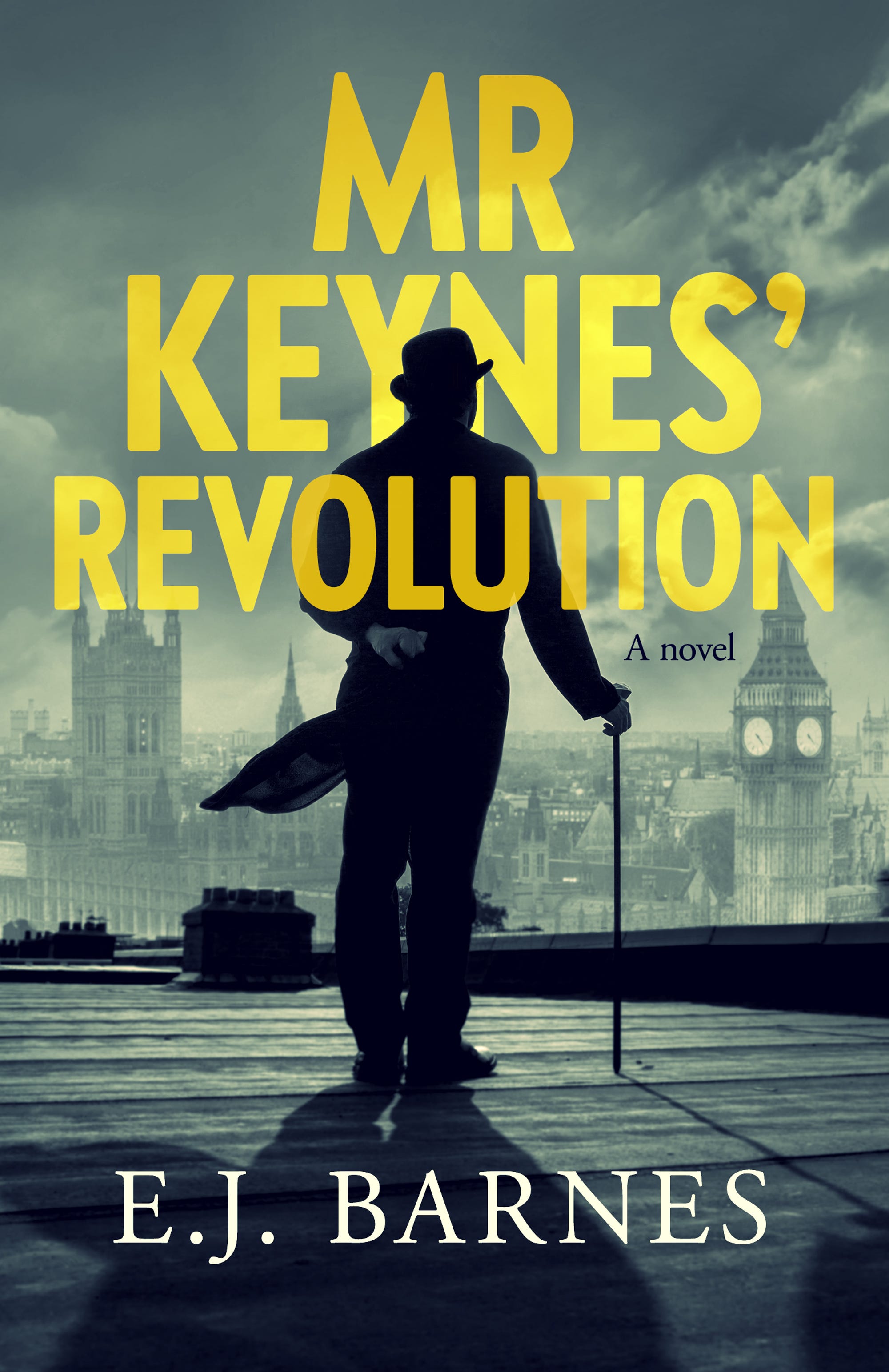
My interest in the 1920s and 30s, political economy between the wars, notable twentieth century writers, the Bloomsbury Group, Cambridge, the descent into World War II and much else I write about on this substack is encapsulated in my two novels about Maynard Keynes and Lydia Lopokova – two of the most remarkable characters of the time and two of the most unlikely lovers. Do give them a try.
Postscript on Potter
Following on from my posts on Beatrix Potter as scientific researcher, and as businesswoman, I’m adding a postscript here on one of the links between the two. Ann Kennedy Smith of Cambridge Ladies' Dining Society commented that she loved the fact that it was Beatrix’s contacts at the National History Museum that led to her finding a printer for her self-published Tale of Peter Rabbit, and this immediately sent me down a rabbit-hole (pun intended). The contacts were the Woodward sisters, and they link to both the scientific and the artistic/literary parts of Beatrix’s life.
Beatrix later commented that she got the name of the printer from:
‘a friend at the Natural History Museum with whom I was working; her father, Dr Woodward, edited The Geological Magazine, and she knew something about engraving and printing.’1
This was Gertrude Woodward, one of the artist daughters of Henry Woodward, a distinguished geologist. Henry’s two sons became scientists, and his five daughters artists. As well as fungi, Beatrix had a passionate interest in fossils, and spent many hours drawing them in the Natural History Museum. It was there she often worked with Gertrude, who was a scientific illustrator, and who became a close friend.
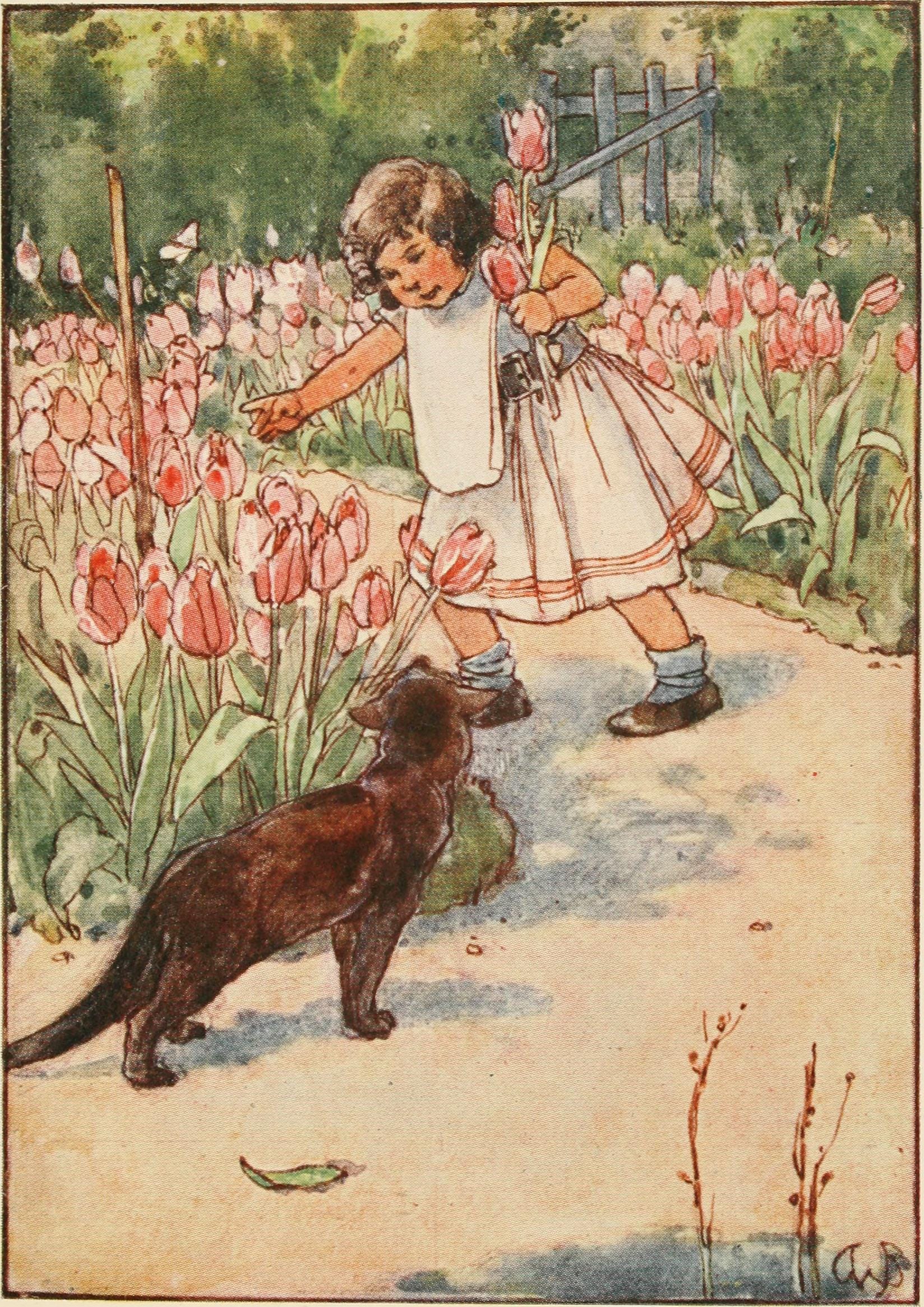
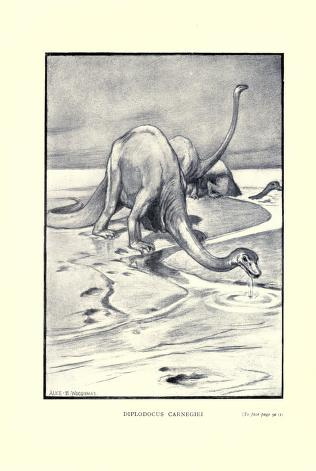
Gertrude’s sister Alice B. Woodward may have been even more important however in the genesis of Peter Rabbit, because Alice was a children’s illustrator, as well as scientific illustrator. Although she’s certainly not a household name now, as a Victorian illustrator she was prolific and illustrated a huge range of work: from versions of classics like Alice in Wonderland and Black Beauty to forgotten fairytales. She also illustrated works of paleontology. If you google her name you will find a startling mixture of children’s fantasy and careful recreations of dinosaurs. She must surely have presented Beatrix with a model of what what possible, as well as practical advice on printers and publishers.
I would guess the Woodwards might have been a picture of the kind of active, large family that Beatrix might have envied – like the Warnes, her publishers and the family of her first fiance – although that’s speculative on my part. Certainly Katharine seems to have been an interesting character, who also worked in naval intelligence during World War I.
Gertrude, who focused on scientific illustration, seems to be have been a lasting and close friend of Beatrix Potter’s. When Beatrix was making her first steps as a northern landowner and farmer, she made a trip north to stay by her first farm when it was renovated. She stayed in lodgings in the village, and Gertrude was her companion. Given that Beatrix had grown up with very limited autonomy – expected to travel with chaperones – Gertrude’s company would have been important in letting Beatrix take her first steps into independence and presumably in disarming opposition to the trip from Beatrix’s parents.
Later Gertrude stayed with Beatrix at the farmhouse, and was there on the occasion when Beatrix trapped a swarm of bees.
It’s interesting that Beatrix, unusual though she was, may nevertheless have been part of a larger network of Victorian women who were interested in art and science and actively pursuing both, and who assisted each other. I started my post on Beatrix Potter and science by way of a book on notable women scientists in the early twentieth century – both the Woodwards’ brothers became scientists, while all the sisters (there were five) became artists. It seems likely some of the girls at least would have become scientists had the way been open: while art and science are often seen nowadays as diametrically opposed, in the Victorian period, was it the case that one was even a substitute for the other?
Uncle Henry Roscoe
Having suggested that Beatrix Potter might have been part of a wider network of women, it’s also important to point out that there were men who did support her scientific endeavours, even if the (at that time) male establishment did treat her ‘scurvily’. One important collaborator was Scottish postman and mycologist Charles McIntosh who helped her gather large amounts of fungi. Like Beatrice, he was an amateur rather than a fully fledged member of the scientific establishment, in his case because of class not sex (although being a rural postman turned out to be the perfect occupation for gathering mushrooms).
Also important, indeed crucial, in terms of getting Beatrix access to Kew and eventually to the Linnean Society, was her '“Uncle Roscoe”. Henry Roscoe was himself an eminent scientist. Once he understood there was merit to what Beatrix was doing he put time and energy into championing her work, personally escorting her to Kew and arranging meetings with the chief scientists there. His involvement was probably important in keeping her parents on side (Beatrix Potter describes in her journal escaping the house in the early morning to wait for him on the street, afraid that she would be summoned back). However, as Linda Lear writes, Roscoe may also have inadvertently got backs up in botanical world: he was eminement, but in chemistry, and would most likely have been seen as over-stepping his territory, and in assistance of an amateur, and a female relative too.
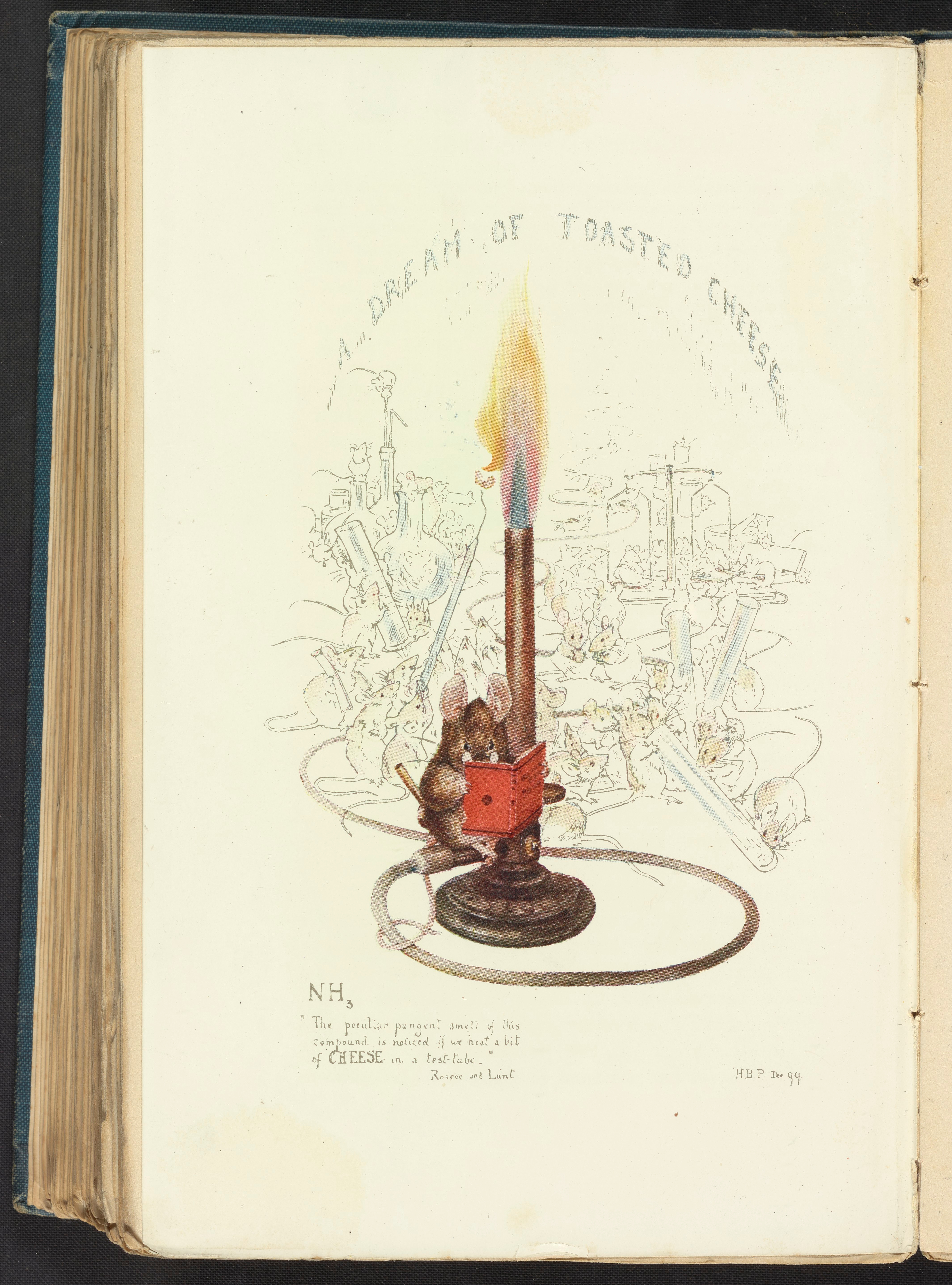
Beatrix’s gratitude produced this wonderful card for her uncle, which combines her love of fantasy, animals and the scientific. It references a textbook on inorganic chemistry that Henry Roscoe wrote which refers to the smell of toasted cheese.
Recommended Reads
Speaking of networks of Victorian and Edwardian women, I was also fascinated by the this post from Deborah Vass – about Helen Bradley, whose work I known, but had not looked at or thought about in a long time. When Beatrix Potter was establishing herself as a Northern farmer in the first years of the twentieth century, Helen Bradley was growing up in the urban North, near Oldham, not so far from Potter’s lakeland farms. These northern locations – mill towns, the familiar landscape of Beatrix Potter’s forbears, have extraordinary natural beauty to them.

Like Potter, Helen Bradley was artisictically gifted, and like her she had business interests (she ran a wool shop). But she had to wait until even later in life for recognition: it was in her late sixties that her pictures of her Edwardian childhood began to inspire interest, enthusiasm and high auction prices.
I heard The February House on radio three piece by accident: it’s about one of the oddest house shares ever. It intrigued me because I’m interested in writers from the thirties, like some of Auden’s poems, and am interested in his Keynes connection (Keynes arranged to show Auden and Isherwood’s play , with mixed success, at the Cambridge Arts Theatre), but althoughI knew Auden left for the USA, I had no idea he ended up sharing a house with a motley assortment of folk that included Carson McCullers, Gypsy Rose Lee, Benjamin Britten and Peters Pears, and that Britten and Auden even wrote an opera together (again with mixed success) about the American revolution.
Quoted in Margaret Lane: The Tale of Beatrix Potter
I love this, Emma - that wonderful Beatrix Potter toasted cheese illustration! someone should reprint it as a birthday card - but really because of what you say about Victorian women's networks, and how (being kept out of formal education) they shared knowledge with others. So interesting, and something I'm looking into with the first women's colleges at Cambridge starting at that time.
Thank you for this article,I loved it. I love Beatrix Potter's illustrations but know very little about her life, so I really enjoyed this article